

What a Murphy Door® Hidden Door Is Made Of
Why we build on Vaultwood Core™
Solid wood warps. Plywood delaminates. Here is the material that stays flat and holds hardware for a lifetime, and why we chose it.
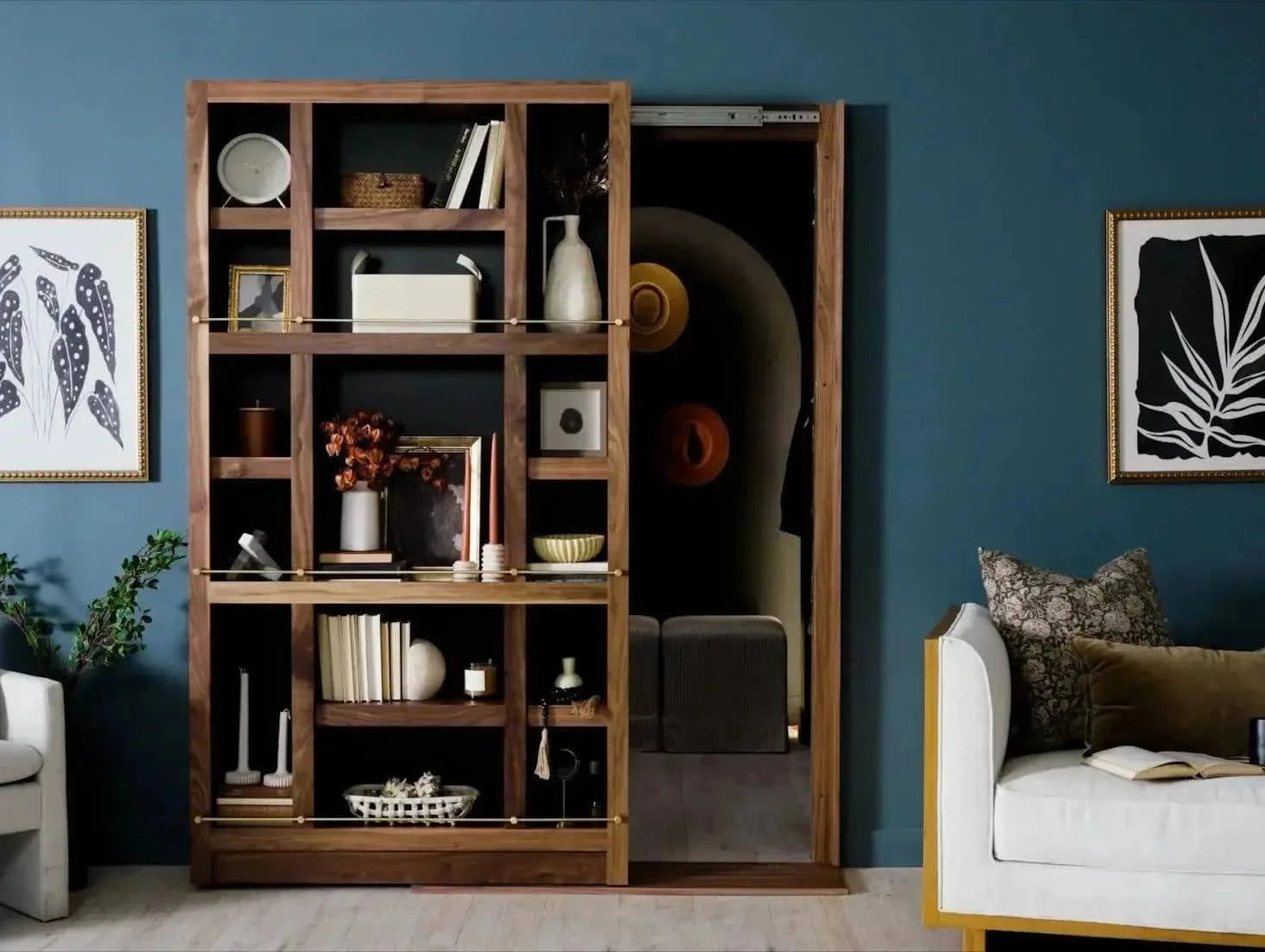
What Vaultwood Core™ is
Vaultwood Core™ is Murphy Door®’s specialized engineered wood core. It is a premium, purpose-built grade of medium-density fiberboard, real wood refined to a uniform fiber and bonded under heat and pressure into one solid panel, produced to our exact minimum specification by leading North American engineered-wood mills. We are straight about what that means: we do not press the panel ourselves. We wrote the specification a hidden-door core has to meet, we hold every panel produced for us to that standard, and we engineered our door systems and patented hidden door hinge system around it. That is the part we engineered, and it is where the performance comes from. The core itself is built for the one thing a hidden door lives or dies by: staying perfectly flat while holding heavy hardware for a lifetime.
A hidden door is not furniture that sits still. It is a moving structural panel that has to close to a precise reveal every time, for decades. That single requirement rules out the materials most people assume are “better,” and it is why we wrote a specification for a core built specifically for the job.
A hidden door cannot move even a little, or it stops closing right. So we build it from a material that does not.
Why not solid wood
Solid lumber is beautiful, and we use a lot of it, on every surface you see and touch. But a large solid slab is the wrong choice for a flush door, because wood moves. It cups, warps, and splits at fasteners as humidity rises and falls, which is exactly why fine cabinet doors are built frame-and-panel instead of as one wide board. A solid slab under constant load also shows a documented behavior called mechano-sorptive creep, a slow bow that gets worse as humidity cycles. A hidden door cannot move even a little, or it stops closing right. Vaultwood Core™ has no continuous grain to bow along, so it stays flat where solid wood would not.
Why not plywood
Plywood is real wood, but it is not solid wood, and it is not suited to making doors. It is thin veneers glued in layers, and as humidity cycles those glue lines fatigue until the plies separate. It hides voids where knots fell out or the glue never bonded, even in cabinet grade. And it rarely arrives dead flat. We know this firsthand: when Murphy Door® started, we built with plywood, and it gave us hundreds of warranty problems, including a big-box retail case in California where humidity swings caused delamination and we took back nearly 200 units. Years later we tested plywood again to see if anything had changed. Nothing could sit flat enough to guarantee. So we stopped using it.
The irony of the “no MDF” pitch
Some makers that advertise “real wood, no MDF” build the load-bearing body and shelves of their doors from cabinet-grade plywood, the very panel most prone to the delamination and warping people fear. Before you buy from anyone, ask which parts are solid lumber, which are plywood, and which are veneer, and get it in writing.
Why not commodity MDF, and how ours is different
Every “avoid MDF” warning you have read is describing the cheapest fiberboard on the market, the bargain panel built down to a price. On that, we agree. Commodity MDF was never meant to carry a loaded bookcase for decades, and we do not use it. Vaultwood Core™ is a different animal: an engineered core held to an exact specification we set, produced for us to order because only the best mills can consistently hit our numbers. Calling it “MDF” because they share a family tree is like calling a purpose-built race engine “a motor.” Same category, different universe.
This costs us more, not less
People assume an engineered core is the cheap way out. For us it is the opposite. We own a hardwood mill, so we know the price of every option down to the board foot, and Vaultwood Core™ costs us more than solid hardwood, plywood, and commodity MDF across most of our material types. We did not choose it to save a dollar. We chose it because it is the only material that does the job for a lifetime, and because standing behind more than 200,000 products shipped with a lifetime warranty is a lot cheaper than replacing the ones that fail. When the material that performs best also costs us the most, the decision is easy.
How we build a door
Good engineering is not loyalty to one material. It is knowing exactly where each one belongs. Every Murphy Door® hidden door pairs top-grade solid hardwood with Vaultwood Core™. The parts you see and touch, the face frames, most cabinet doors, and some trim, are solid, top-grade hardwood. Always. Never finger-jointed. Behind them, where the job is to stay flat and hold hardware for a lifetime, is Vaultwood Core™, with the hardwood fastened directly to it so the show-wood is locked to a structure that will not warp or bow. Every door also ships with a half-inch structural back panel as standard, twice the thickness of a standard quarter-inch back panel, with a three-quarter-inch upgrade available for the heaviest loads.

The materials, side by side
| Property | Vaultwood Core™ | Commodity MDF | Plywood | Solid hardwood |
|---|---|---|---|---|
| What it is | Premium engineered fiber core, built to our spec | Fine fiber, built to a price | Glued wood veneers | Milled lumber |
| Breaking strength, MOR (PSI) | 5,000+ | ~3,500 to 4,000 | Varies, delaminates | High, but splits along grain |
| Stays flat under load | Stays flat | Fair | Warps, bows | Cups, warps |
| Moisture behavior | Resin resists moisture | Swells if unsealed | Delaminates | Swells, cups |
| Screw hold, face | Top of the group (~350 to 400 lbs) | ~300 to 400 lbs | Weak at edges and voids | Strong along grain, can split |
| Formaldehyde | Meets TSCA Title VI / CARB Phase 2 | Meets TSCA Title VI (0.11 ppm) | Meets TSCA Title VI | None if truly solid |
On top of the panel itself, every Murphy Door® hidden door is carried by a hinge and hardware system tested to 1,540 lbs and holds up to 400 lbs of shelf load on doors up to 36 inches wide, on top of its own weight. Our test data, the Vaultwood Core™ specification sheet, and our warranty record are available on request. If a competitor makes a performance claim, ask them for the same.
So is it “real wood” or “MDF”?
Both words, honestly, tell you almost nothing. Plywood is real wood veneers glued together. MDF is real wood fibers glued together. They are all engineered wood; the main difference is how finely the wood is broken down before it is pressed into a panel. So the questions that actually matter are which material is used for which part, and whether the maker will show you the numbers. On a Murphy Door® hidden door, the answer is simple: solid hardwood on every surface you see, Vaultwood Core™ where the panel has to stay flat, and the proof available on request.
Read the full story: The Core of the Matter ›
Frequently asked
Is a Murphy Door® hidden door made of MDF?
The surfaces you see and touch are solid, top-grade hardwood. Behind them is Vaultwood Core™, our specialized engineered core, a premium, purpose-built grade of MDF built for the weight and motion of a hidden door. It is not the commodity fiberboard sold at big-box stores; it is built to our exact specification and carries a lifetime warranty.
Why an engineered core instead of solid wood?
A hidden door has to stay perfectly flat for a lifetime. Solid wood cups, warps, and splits at fasteners as humidity changes, which is why fine doors are built frame-and-panel rather than as a single slab. Vaultwood Core™ has no continuous grain to bow along, so it stays flat and holds hardware where solid wood would move.
Is Vaultwood Core™ stronger than plywood?
For a door panel, it is more suitable. Plywood can be strong along its grain, but it hides voids and delaminates as its glue lines fatigue, and it rarely stays dead flat. Vaultwood Core™ is uniform and void-free, resists moisture, and stays flat, which is what a flush hidden door needs. We tested plywood twice in our history and could not guarantee it.
How much weight can a Murphy Door® hidden door hold?
Every door is carried by a hinge and hardware system tested to 1,540 lbs, and each door holds up to 400 lbs of shelf load on doors up to 36 inches wide, on top of its own weight. Sag is controlled by that hardware system, not by whether the core is solid wood.
Is it safe? What about formaldehyde?
Composite wood sold in the United States must meet the federal TSCA Title VI standard, the same limits as California CARB Phase 2, among the strictest formaldehyde standards in the world. Vaultwood Core™ is built to that standard.