

Materials, Explained
What is a hidden door made of?
From the surface you touch to the core you never see, here is what actually goes into a hidden bookcase door.
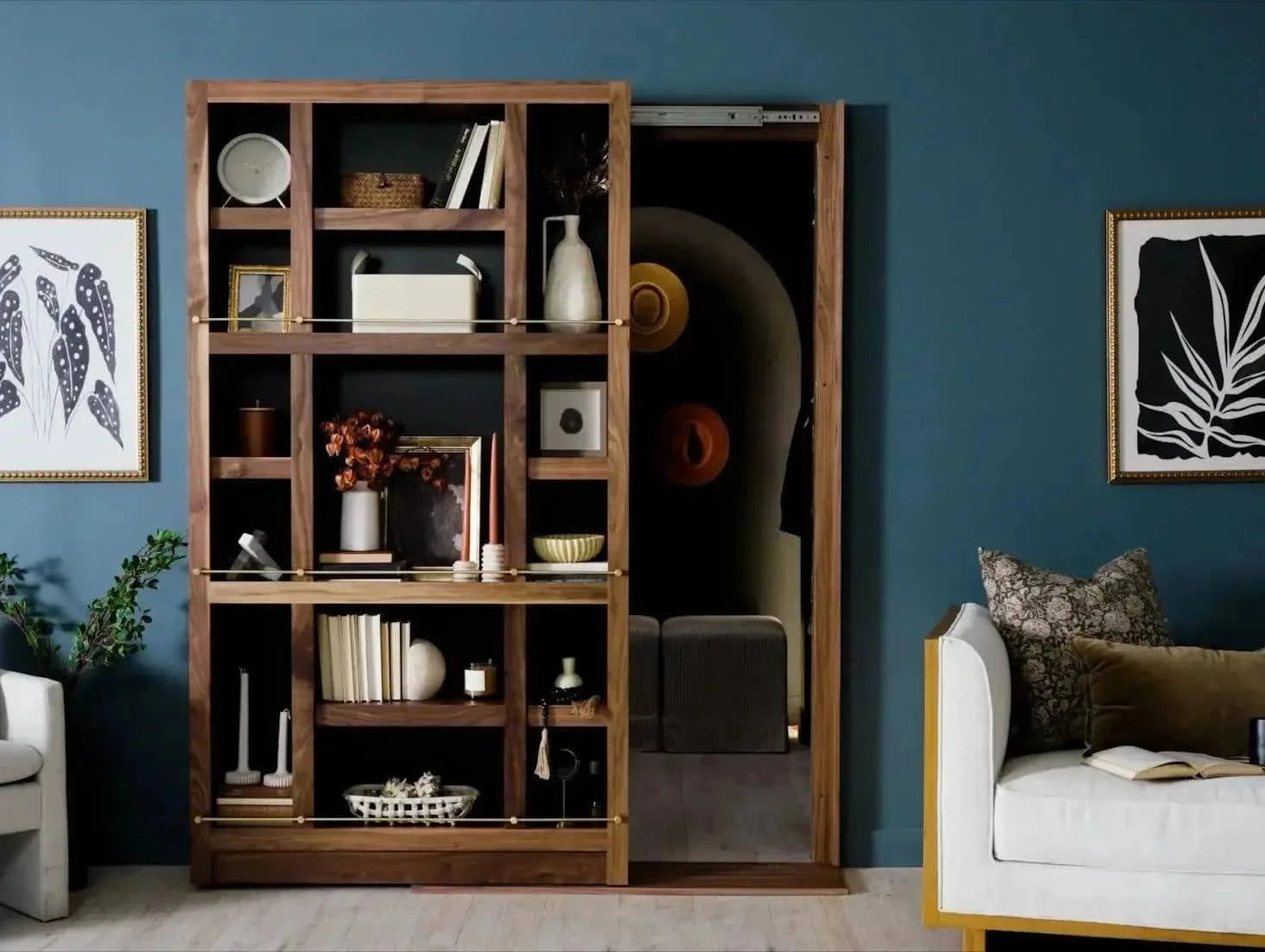
The short answer
A hidden door has to do two things at once that pull against each other: look like beautiful furniture, and behave like a precision machine part that closes to a perfect seam every time for decades. No single material does both well. So a well-built hidden door combines materials, each placed exactly where it performs best. Here is the breakdown, part by part.
Part by part
The face frame and surfaces you see
Solid, top-grade hardwood, oak, maple, cherry, alder, walnut, and the like. This is the wood you touch, stain, and show off. On a quality door it is real solid lumber, never finger-jointed or low-grade show wood used to shave cost.
The core, the panel behind the show wood
This is the part that gives the door its shape and has to stay dead flat under load for a lifetime. A single solid-wood slab is the wrong choice here because wood cups and warps with humidity, and plywood is prone to voids and delamination. The right material is a purpose-built engineered core. On a Murphy Door® hidden door that is Vaultwood Core™, a premium engineered core built to our exact specification, with the hardwood fastened directly to it.
The back panel
The structural back that squares and stiffens the whole assembly. Thickness matters here: every Murphy Door® hidden door ships with a half-inch structural back as standard, twice the thickness of a standard quarter-inch back, with a three-quarter-inch upgrade for heavy loads.
The hinge and hardware system
The part that actually carries the door and lets it swing and latch. This is what determines whether a door sags, not the wood. A Murphy Door® hidden door rides on a hinge and hardware system tested to 1,540 lbs and holds up to 400 lbs of shelf load on doors up to 36 inches wide, beyond the door's own weight.
The finish
Stain, paint, or clear coat over the hardwood and paintable surfaces, which also seals the wood against moisture. Interior use, sealed properly, is what keeps everything stable.
Good engineering is not loyalty to one material. It is knowing exactly where each one belongs.
Why the mix, and not one material
People sometimes want a door that is “all solid wood,” but that is a romantic idea, not a durable one. A giant solid slab moves, cups, and eventually stops closing flush. Building the whole thing from plywood invites delamination and voids. The strongest, longest-lasting hidden doors put solid hardwood where you see and touch it, and a stable engineered core where the panel has to stay flat. Right material, right place.
What to check before you buy
Some makers advertise “real wood” while building the load-bearing body and the shelves from cabinet-grade plywood. That is worth knowing. Ask any company which parts are solid lumber, which are plywood, and which are veneer, and ask to see it in writing.
On a Murphy Door® hidden door
Solid, top-grade hardwood on every surface you see and touch. Vaultwood Core™ where the panel has to stay perfectly flat. A half-inch structural back as standard. A hinge and hardware system tested to 1,540 lbs. All handmade in the USA, proven across more than 200,000 products shipped, and backed by a lifetime warranty.
Read the full story: The Core of the Matter ›
Frequently asked
What is a hidden bookcase door made of?
Several materials, each for a job: solid hardwood on the face frame and surfaces you see, an engineered wood core behind them so the panel stays flat, a structural back panel, and a rated hinge and hardware system. On a Murphy Door® hidden door, the visible surfaces are solid hardwood and the core is Vaultwood Core™.
Are hidden doors solid wood?
The visible parts usually are. But a single solid-wood slab is the wrong choice for the full panel because wood warps and cups, so the panel behind the show wood is an engineered core. Some makers use plywood for the body and shelves, so ask which parts are solid, plywood, or veneer.
What is the core of a hidden door?
The panel that gives the door its shape and flatness. It has to stay dead flat under load for decades, so a purpose-built engineered core is the right material. Murphy Door® uses Vaultwood Core™, built to its exact specification.
Are the shelves solid wood?
It depends on the maker. Some makers build shelves and the body from cabinet-grade plywood even when they advertise real wood. Ask for the material of each part in writing before you buy.
