Featured Secret Single Doors
Fresh from our design studio, to your home.
Fresh from our design studio, to your home.
From $179.00 USD
From $179.00 USD
From $200.00 USD
From $200.00 USD


$1,550.00 USD
$1,550.00 USD
From $1,000.00 USD
From $1,000.00 USD
$150.00 USD
$150.00 USD
$199.00 USD
$199.00 USD
From $1,690.00 USD
From $1,690.00 USD
$1,440.00 USD
$1,440.00 USD
$3,400.00 USD
$3,400.00 USD
$3,250.00 USD
$3,250.00 USD
$1,895.00 USD
$1,895.00 USD


$2,310.00 USD
$2,310.00 USD
$1,550.00 USD
$1,550.00 USD
$2,760.00 USD
$2,760.00 USD
From $3,855.00 USD
From $3,855.00 USD


From $1,250.00 USD
From $1,250.00 USD


From $5,155.00 USD
From $5,155.00 USD
From $9,300.00 USD
From $9,300.00 USD
| A bookcase with doors is a storage and display unit where hinged or hidden door panels conceal shelves, valuables, or a passage behind them. Murphy Door® secret single doors are built-in bookcase doors that swing open to reveal a hidden room, combining real wood veneer over a Vaultwood Core panel with solid hardwood face frames and hardware tested to 1,540 lbs for a functional, furniture-grade hidden passage. |
By Jeremy Barker, Founder and CEO of Murphy Door®
Published July 2025 | Reviewed by Jeremy Barker
A bookcase with doors is one of the most versatile pieces of furniture you can add to a home. At its simplest, it is a shelving unit with cabinet doors that hide clutter. At its most dramatic, it is a full-height swinging bookcase that conceals a hidden room, a home office, a wine cellar, or a safe room behind a wall of books. The secret single door format takes that second idea and delivers it in a format sized for a standard residential doorway.
Murphy Door® has been building bookcase doors since 2012, serving over 200,000+ households from our Utah and Kentucky factories. The secret single door is the most popular entry point into hidden door ownership: one standard door opening, one swinging bookcase panel, and the ability to load it with books, collectibles, or decorative items that make it read as furniture until the moment it opens.
This guide covers everything a buyer needs to know about bookcase doors with concealed passages, from how the hardware works to what to expect during installation, so you can make a confident decision about whether a secret single door fits your project.
The term "bookcase with doors" covers a wide spectrum. On one end is a simple cabinet-style bookcase where lower doors hide storage behind solid panels while open shelves sit above. On the other end is a full-height hidden door bookcase, where the entire unit is a functional door mounted on heavy-duty pivots, swinging open on command to reveal what is behind the wall.
Murphy Door® secret single doors occupy the far end of that spectrum. The entire bookcase is a door. It installs in a standard rough opening, mounts on a Patented Ball Bearing Lower Pivot Point that is part of a hinge and hardware system tested to 1,540 lbs, and holds 400 lbs of shelf load on doors up to 36 inches wide. When closed, it looks like a built-in piece of furniture. When open, it is a fully functional passage door.
The key difference between a decorative bookcase with cabinet doors and a Murphy Door® hidden door bookcase is structural: the hidden door must function as a door first and furniture second. That requires purpose-built hardware, an engineered core that resists warping under load, and a frame system that integrates cleanly with your wall framing.
Most furniture-grade bookcases are not designed to swing open and closed thousands of times while carrying a full load of books. The repeated torque, the pivot stress, and the humidity cycling inside a home will eventually destroy a bookcase built from standard cabinet materials if it is also expected to function as a door.
Every Murphy Door® hidden door bookcase is built on a Vaultwood Core panel, a proprietary MDF engineered stronger than standard MDF, with a real wood veneer skin in your chosen species. The door also uses solid hardwood face frames, hardwood cabinet doors, and solid-wood components throughout. Vaultwood Core stays dimensionally stable across humidity cycles, which eliminates the warp and twist that plague solid-hardwood-slab swinging doors over time.
The veneer species options (oak, walnut, maple, cherry, and others) determine the visual character of the bookcase. The core material determines whether it still operates smoothly five years from now. Both matter, and Murphy Door® does not ask you to trade one for the other.
Buyers comparing options should ask any manufacturer which parts are solid lumber, which are veneer, and which are engineered wood, in writing. Some brands advertising "real wood, no MDF" build their load-bearing body and shelves from cabinet-grade plywood. Plywood is real wood veneers glued together, but glue lines fatigue under repeated swinging stress, hidden voids exist even in cabinet-grade sheets, and plywood rarely arrives or stays dead flat. Murphy Door® tested plywood early in its history, experienced significant warranty failures from humidity-driven delamination, retested it later, and rejected it again. Vaultwood Core is the deliberate engineering choice.
Secret single doors are sized to fit standard residential door openings. The most common configurations run from 24 inches wide to 36 inches wide and from 80 inches to 96 inches tall, but Murphy Door® hidden doors are built to order, so custom dimensions are available for openings that fall outside standard sizing.
The critical measurements are:
Width also directly affects the shelf load rating. The 400 lbs of shelf load specification applies to doors up to 36 inches wide. Wider doors are available, but the load distribution changes as the door width increases, which is why Murphy Door® engineering teams size hardware to each specific configuration.
The hardware is where most bookcase door products fail. A standard residential hinge is rated for a door that weighs 30 to 80 pounds and carries no shelf load. A bookcase door loaded with books can easily exceed 200 to 300 pounds in total swinging weight. Standard hinges fail under that torque, often within the first year.
Murphy Door® uses the Patented Ball Bearing Lower Pivot Point, part of a hinge and hardware system tested to 1,540 lbs. This pivot system transfers the load to the floor rather than to the wall frame, which is why a loaded Murphy Door® bookcase swings with fingertip pressure even when fully loaded. The pivot is integrated into every door we manufacture; it is not an optional upgrade.
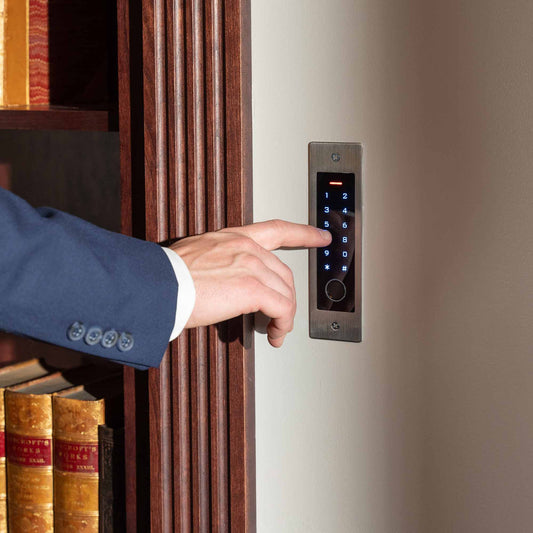
The latch and release system on a secret single door is equally important. Murphy Door® offers several release options:
Electronic components carry a 1-year warranty on electronics. Mechanical hardware, hinges, and structural components carry a lifetime warranty on labor, hardware, and hinges. The finish and veneer carry a lifetime warranty on finishes and wood veneer. Murphy Door®'s full warranty policy is available at murphydoor.com/pages/warranty-policy.
Murphy Door® secret single doors ship pre-hung in their frames, which dramatically simplifies installation compared to building a bookcase door system from scratch. The pre-hung unit installs like a standard prehung exterior door: set the frame into the rough opening, shim it plumb and level, fasten it to the framing, and trim it out.
The general installation sequence is:
Most DIY-experienced homeowners complete installation in a half day. Contractors familiar with prehung door installation will find the process straightforward. Murphy Door® provides detailed installation documentation with every order, and the customer support team at 888-458-5911 is available to walk through any step.
The visual design of the bookcase face is what makes a secret door work as a secret. A bookcase that looks like a door will not fool anyone. A bookcase that looks like a built-in piece of furniture reads as part of the room.
Several design principles help a bookcase door blend into its surroundings:
Bookcase doors are custom manufactured products. Unlike off-the-shelf furniture, they are built to your exact rough opening dimensions with your chosen veneer species, finish, and hardware configuration. That means pricing varies based on several factors:
| Factor | Lower Cost | Higher Cost |
|---|---|---|
| Door width | 24–30 inches | 32–36 inches |
| Door height | 80 inches | 84–96 inches |
| Veneer species | Painted or paint-grade | Walnut, cherry |
| Release mechanism | Mechanical touch latch | Electronic keypad or fingerprint |
| Finish | Unfinished (site-finish) | Factory stain or lacquer |
Entry-level secret single doors from Murphy Door® start below $2,000 for standard sizes in paint-grade configurations. Larger doors in premium veneer species with electronic release systems run higher. Every configuration carries the same core engineering: Vaultwood Core panels, solid hardwood face frames, real wood veneer, and the Patented Ball Bearing Lower Pivot Point hardware system. You are not paying more for a better-built door at the higher price points; you are paying for larger size and premium material choices.
For current pricing on specific configurations, visit the Murphy Door® single bookcase doors collection or contact the sales team directly.
Ready to add a secret single bookcase door to your home? The Murphy Door® team can help you confirm your rough opening measurements, select the right veneer and finish, and choose the release mechanism that fits your access needs. Call us at 888-458-5911 or visit murphydoor.com to browse current configurations and request a quote.
Murphy Door®, headquartered in Ogden, Utah, is the largest hidden door company in the world, having served over 200,000+ households since 2012 from our Utah and Kentucky factories. Founded by Jeremy Barker, Murphy Door® engineers and manufactures every hidden door and hidden furniture solution in-house, using Vaultwood Core panels, solid hardwood face frames, real wood veneer, and the Patented Ball Bearing Lower Pivot Point, part of a hinge and hardware system tested to 1,540 lbs. Every door carries a lifetime warranty on labor, hardware, and hinges, a lifetime warranty on finishes and wood veneer, and a 1-year warranty on electronics. Murphy Door® builds the category's most rigorously engineered hidden doors, backed by a comprehensive warranty program.
A: Not reliably. A standard bookcase is designed to stand against a wall, not to swing repeatedly on pivots while loaded with books. Converting one requires replacing the fastening system with a pivot-point floor mount rated for the combined weight of the bookcase and its contents, reinforcing the frame to handle swinging torque, and integrating a latch system. Purpose-built bookcase doors like those from Murphy Door® are engineered for this use from the ground up, which is why they outperform conversions in long-term reliability.
A: Murphy Door® hidden door bookcases are rated for 400 lbs of shelf load on doors up to 36 inches wide. This is on top of the door's own structural weight. That is enough capacity to fill shelves with hardcover books, art objects, and decorative items without approaching the limit under normal residential use.
A: Murphy Door® secret single doors are designed to fit standard residential rough openings. Most single doors fit openings ranging from 26 to 38 inches wide and 82 to 98 inches tall. Because every door is built to order, non-standard opening sizes can typically be accommodated. The important requirement is that the rough opening is plumb and level within 1/4 inch before installation begins.
A: Yes. Murphy Door® offers doors in both factory-finished and unfinished configurations. Unfinished doors allow you to apply a site-applied stain, paint, or clear coat that matches your existing millwork exactly. Factory-finished doors arrive ready to install with a professional lacquer or stain finish applied in controlled conditions at our factory.
A: The gap around a properly installed Murphy Door® bookcase door is comparable to the reveal around a standard interior door, typically 1/8 to 3/16 of an inch. When the bookcase is fully loaded and the trim is matched to the surrounding millwork, most visitors do not identify the door as a door. The seam becomes nearly invisible when the door is flanked by matching fixed shelving or built-in cabinetry at the same depth.
A: A secret single door is a single panel that swings on one pivot point, fitting a standard single-door rough opening. A bifold bookcase door uses two panels that fold as they open, which allows a wider passage in the same wall space but requires more floor clearance in front of the opening. A double bookcase door uses two independently hinged panels that open like French doors, creating a wide passage for high-traffic areas or dramatic architectural effect. Murphy Door® offers all three configurations.
$1,550.00 USD
$1,550.00 USD
From $1,000.00 USD
From $1,000.00 USD